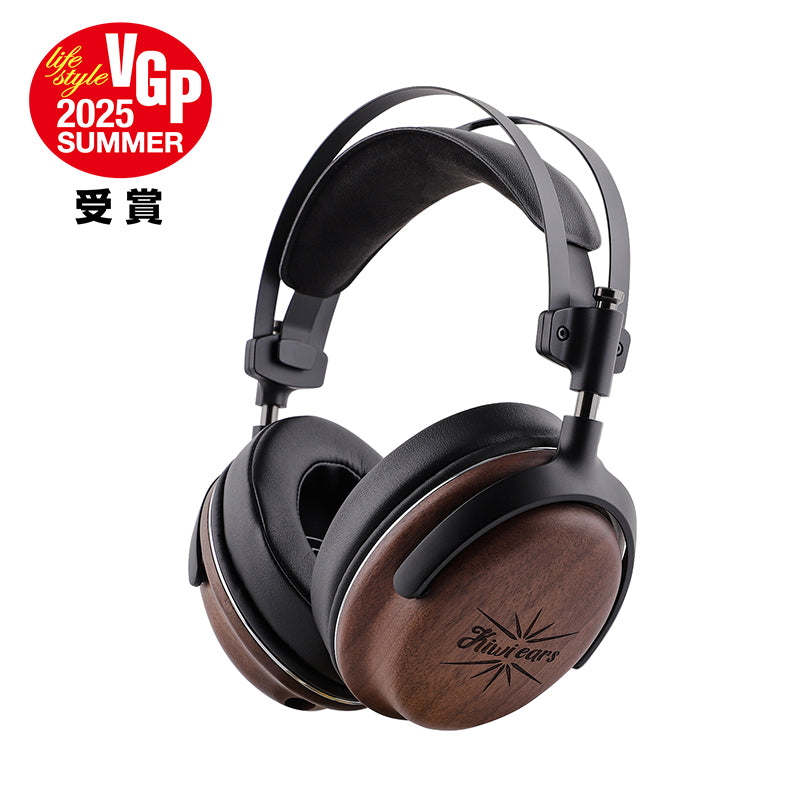
KIWI EARS SERIES · FULL-SIZE HEADPHONES
Stage Series brings Kiwi Ears tuning into full-size wired headphones. Choose a foldable monitor for practical work, an open-back dynamic design for spacious home listening, or a premium dynamic-planar hybrid for scale and detail.
Full-size, still natural.
FROM THE PRACTICE ROOM TO THE LISTENING ROOM
Stage is not one headphone in three price tiers. Each model changes the enclosure, driver system, and use case to fit a different listening environment.
Division folds down for monitoring, practice, DJ work, and practical wired use. Ellipse opens the enclosure around a 50 mm dynamic driver for a broader, speaker-like presentation. Atheia combines a 50 mm dynamic driver with a 14.5 mm planar driver to unite bass scale, tonal body, and faster upper-range detail.

Foldable · Practical · Direct
Portable Monitoring
A compact wired headphone built to move between practice, home studio, DJ, and everyday listening.
Best for
Creators, musicians, students, and users who need a work-ready closed format.

Spacious · Balanced · Comfortable
Open-Back Listening
A vented 50 mm dynamic design creates more air and lateral room for quiet-room listening.
Best for
Albums, live recordings, gaming, and desktop use where leakage is acceptable.
Dynamic · Planar · Extended
Hybrid Flagship
Two driver technologies divide body and speed across a premium full-size platform.
Best for
Critical listening, large-scale music, and listeners who want the most advanced Stage architecture.

Larger physical scale
Full-size diaphragms move more air and present bass, dynamics, and space differently from compact IEMs.
Long-session comfort
Over-ear pads distribute contact around the ear rather than sealing inside the canal.
A source-ready signal path
Detachable wired connections pair directly with interfaces, DAC/amps, receivers, and desktop systems.
Enclosure choice matters
Closed or practical monitor designs prioritize isolation and utility; open-back designs prioritize airflow and spatial openness.
What defines the series
FULL-SIZE ACOUSTIC DESIGN
Stage products use the additional scale of a full-size headphone to explore open and closed acoustics, larger driver platforms, physical damping, and long-session ergonomics. Each model is built around a distinct job rather than a shared shell.
Enclosure Strategy
Open and closed structures determine isolation, airflow, bass behavior, perceived scale, and interaction with the room.
Driver System
Dynamic and multi-transducer configurations are selected according to the desired balance of impact, speed, extension, and control.
Damping & Airflow
Internal materials, vents, rear volume, and baffle geometry regulate resonance and shape the final response.
Fit & Source Matching
Pad geometry, clamp, weight distribution, cable behavior, and drive requirements influence the complete listening experience.
Compare the series
| Comparison |
Kiwi Ears
Division
|
Kiwi Ears
Ellipse
|
|---|---|---|
| Format | Foldable monitor | Open-back over-ear |
| Architecture | 40 mm dynamic | 50 mm dynamic |
| Primary strength | Practical utility | Spatial openness |
| Best environment | Practice, studio, DJ, portable wired use | Quiet home, desk, gaming |
| Main consideration | More compact stage | Open-back leakage |
Kiwi Ears
Division
Kiwi Ears
Ellipse
Qualitative comparison only. Individual fit, tips, and source can change what you hear.
Before you buy
Choose open-back when you listen in a quiet room and value airflow and spatial openness. Choose a closed or monitoring design when isolation, reduced leakage, and practical use around other people matter more.
It depends on sensitivity, impedance, and listening level. Division and Ellipse are designed for accessible wired use; Atheia benefits from a capable source. Check each product specification rather than assuming one answer for the series.
Full-size headphones avoid an in-canal seal, can be more comfortable for some listeners, and create a different sense of driver scale and spatial presentation. IEMs remain smaller, more isolating, and easier to carry.
The dynamic driver provides bass weight and tonal body, while the smaller planar driver is used for faster upper-range response and detail. The final result still depends on crossover and acoustic integration.
Popular searches
Products