Physical low-pass crossover
The low-frequency contour is created through acoustic geometry rather than treating the dynamic driver as an unrestricted full-range source.
Patented & proprietary acoustics
KARS 2.0 controls a dynamic driver through acoustic geometry. KVT adds a mechanically coupled tactile layer through the IEM shell. Different mechanisms — one music-first goal.

A modeled airflow path establishes acoustic loading and a controlled low-frequency handoff.
An electrically actuated plate transfers controlled vibration into the shell and its contact points.
Beyond the driver list
A driver creates motion. The acoustic system decides how that motion reaches the listener. KARS 2.0 and KVT focus on two different parts of that journey: pressure control and mechanical sensation.
Neither technology is added for complexity. Each exists to solve a specific listening problem while preserving Kiwi Ears' natural, coherent house approach.
Kiwi Acoustic Resonance System 2.0
KARS 2.0 is a physical acoustic low-pass crossover. A modeled labyrinth behind the dynamic driver regulates airflow and establishes a precise low-frequency handoff without treating bass as an afterthought.

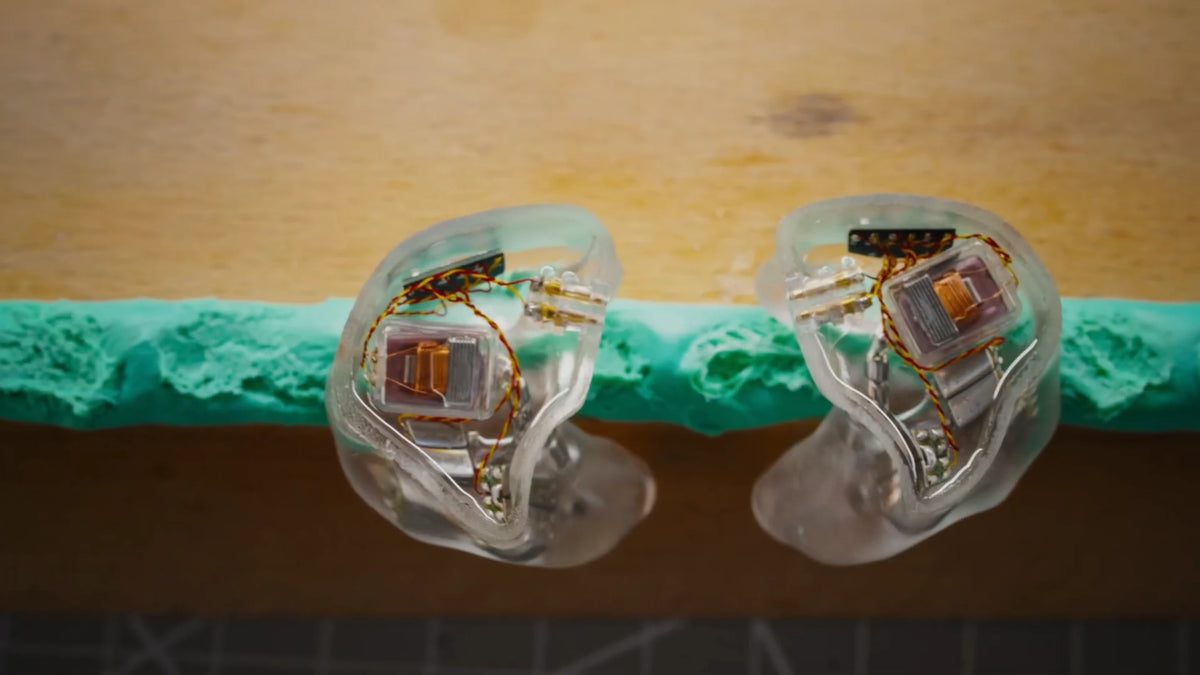
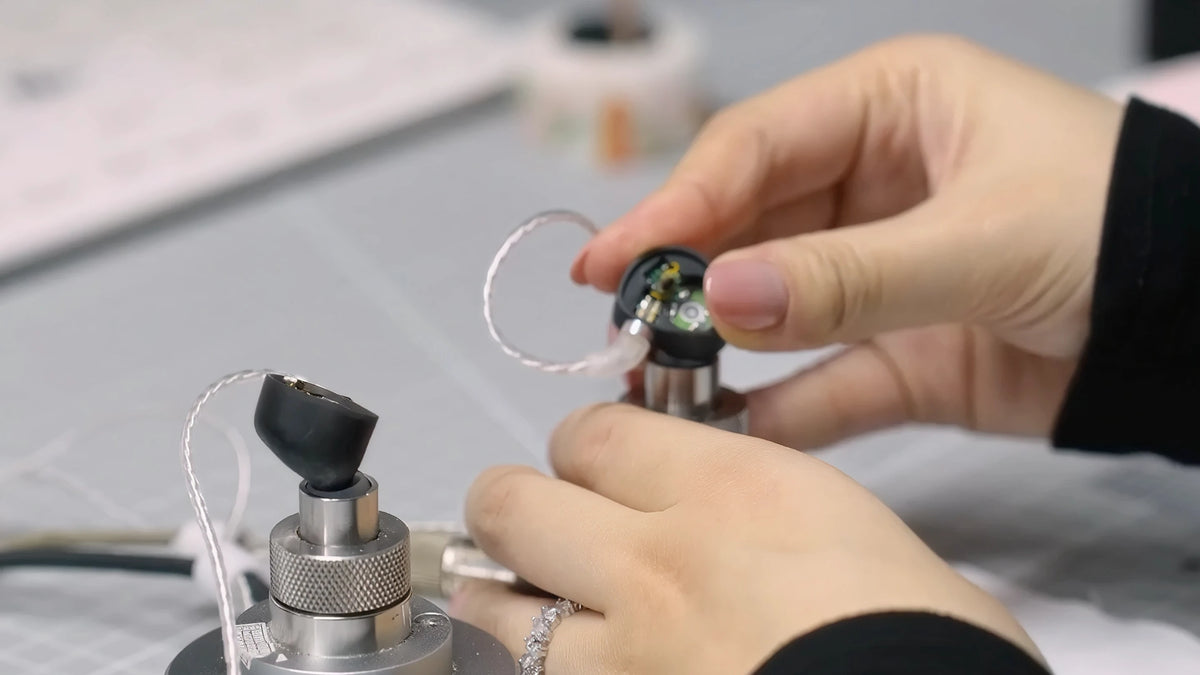
The low-frequency contour is created through acoustic geometry rather than treating the dynamic driver as an unrestricted full-range source.
Acoustic shaping preserves the natural excursion, texture and cohesion of a single dynamic driver while controlling where its bass energy hands off.
KARS 2.0 is integrated into the shell and tuned through calculated dimensions and micrometer-scale adjustment for tighter production control.
The KARS evolution
The first KARS implementation established the principle. KARS 2.0 refines how the labyrinth, driver and shell are designed as one controlled structure.
KARS
Original platform
A precisely tuned air path regulates the custom dynamic driver without adding a conventional passive electrical low-pass network for that role.
Applied in SingoloKARS 2.0
Next generation
The labyrinth is matched to a new titanium-coated PET driver, with improved structural integration and finer dimensional control.
Applied in Cadenza IIKiwi Vibration Transducer
KVT is an in-house vibration-transducer platform designed to reinforce low-mid energy through mechanical coupling. It complements airborne sound instead of trying to replace it.

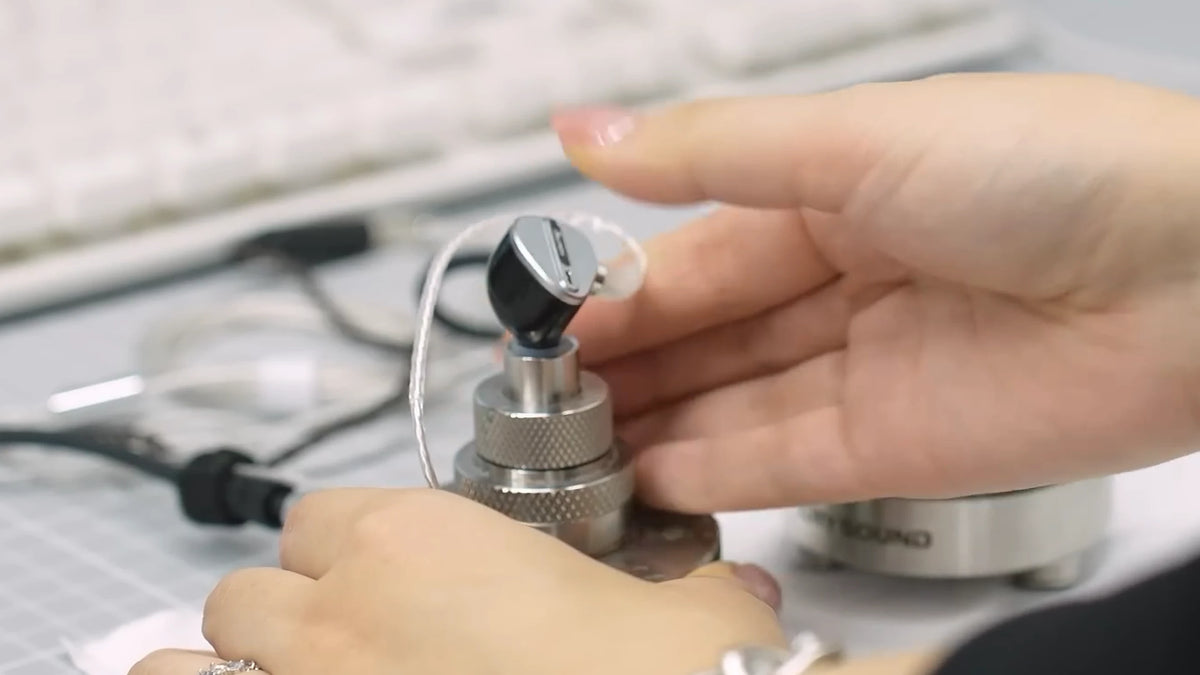

Mechanical energy reinforces the physical character of kick drums, bass guitar fundamentals and lower instrumental resonance.
KVT works alongside the airborne driver system. It does not replace the dynamic driver or act as a substitute for tonal tuning.
The sensation depends on shell mounting, contact pressure, ear anatomy, listening level and the low-frequency content of the recording.
Two different problems
Both technologies operate beyond a conventional driver list, but they act on different energy paths and should not be described as interchangeable.
Engineering method
A proprietary component only matters when it integrates cleanly with the driver, shell, crossover and final tuning.
Start with the intended bass contour, tactile behavior and overall musical balance — not the novelty of the mechanism.
Calculate path dimensions, moving systems, chamber geometry and mounting before producing physical iterations.
Evaluate frequency response, distortion, channel matching and how the technology behaves inside the finished shell.
Confirm that impact, warmth, clarity and fatigue remain coherent across genres, sources, fits and listening levels.
Technology in the lineup
These are the current reference applications for the KARS platform and KVT — each one a different answer to the same music-first brief.
1DD · KARS 2.0 · Current generation
Kiwi Ears
Cadenza IIA 10 mm titanium-coated PET dynamic driver paired with KARS 2.0 for an 8 dB sub-bass shelf, a clean 200 Hz cutoff and a natural midrange transition.
1DD + 3BA · KVT · Tactile platform
Kiwi Ears
ÉtudeA beryllium-plated dynamic subwoofer and three balanced armatures are joined by KVT, adding a distinct low-mid tactile layer to the acoustic system.
References, not a ranking — product-specific tuning figures belong to each product, not to the platform.
The principle
“Technology should make the music feel more inevitable — not more complicated.”
KARS 2.0 and KVT are different answers to the same engineering question: how can the complete earphone deliver more control, more physical truth and less distraction?
Technology FAQ
No. KARS 2.0 is a physical acoustic system built into the IEM. Its labyrinth controls airflow and acoustic loading behind the dynamic driver. The exact implementation is tuned for the driver and shell.
No. It changes how an existing dynamic driver operates inside the enclosure. In Cadenza II, one dynamic driver still reproduces the complete audible spectrum.
No. KARS is an engineering platform, not a fixed target curve. Path geometry, driver choice and shell design are adjusted for each product. The 8 dB shelf and 200 Hz cutoff discussed here are specific to Cadenza II.
No. KVT uses a suspended magnetic vibration assembly and conduction plate, closer in principle to a miniaturized vibration speaker. It transfers mechanical energy through the shell rather than being described as a conventional bone-conduction system.
Mechanical coupling depends on shell contact, insertion, ear anatomy, ear-tip choice, playback level and the recording's low-frequency content. The audible tuning remains important even when the tactile layer is subtle.
The mechanisms are conceptually compatible because they solve different problems. Any combined product, however, would require its own driver matching, chamber design, crossover work and validation; no such product is implied by this page.
Explore the result
See how Kiwi Ears applies acoustic engineering to products tuned for balanced, powerful, vocal, warm and spacious sound.
Popular searches
Products


